

FINANCIAL SUPPORT
FOR CIMZIA®
(certolizumab pegol)
What kind of insurance do you have?
Select your insurance type below to learn more about your options.
What is commercial insurance?
Commercial insurance is insurance that is paid for through a private company. This is typically provided by an employer or purchased on the healthcare marketplace.
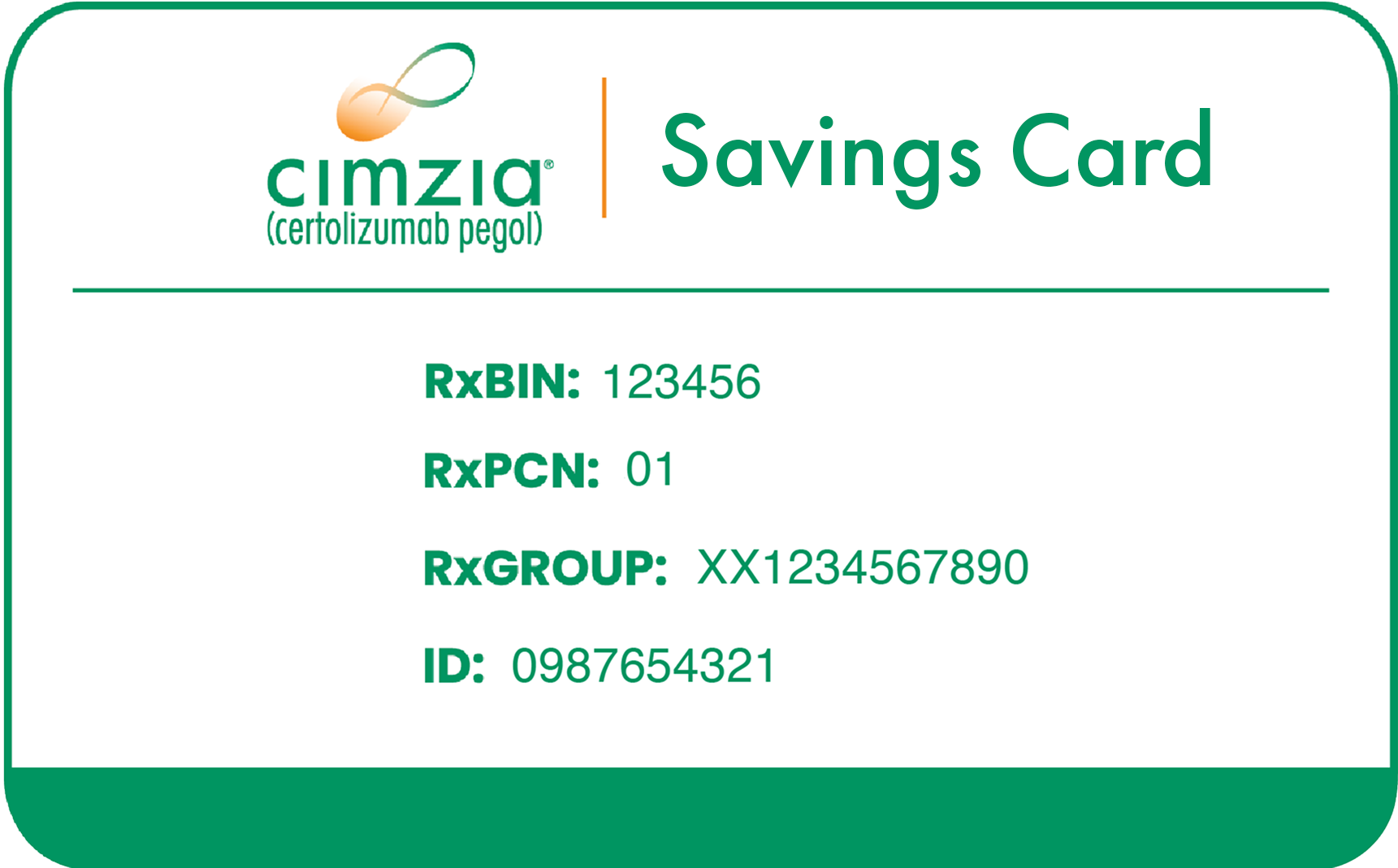
CIMplicity® Savings Program
If you are commercially insured, you may be eligible to receive CIMZIA for as little as $0 per dose.*

CIMplicity Administration Savings
Eligible, commercially insured patients with approved insurance coverage may receive reimbursement for costs incurred related to the in-office administration of CIMZIA Lyophilized Powder, subject to an annual cap and submission of an Explanation of Benefits (EOB) form to CIMplicity.† Contact a CIMplicity Nurse Navigator to learn more about additional support options that may be available.‡
1-844-822-6877
8am–8pm ET, Monday–Friday
†Eligible, commercially insured patients with approved coverage may receive reimbursement for costs incurred for in-office administration of CIMZIA Lyophilized Powder, subject to an annual cap and submission of an Explanation of Benefits (EOB) form to CIMplicity. View complete eligibility requirements and terms at CIMZIA.com/Terms-and-Conditions.
‡Nurse Navigators do not provide medical advice and will refer you to your healthcare professional for any treatment-related questions.
Medicare is administered by the US government and is typically only available to people age 65 years and over.
CIMZIA is covered under the Medicare Part D program. Medicare Part D helps eligible people cover the cost of their prescription drugs.
Learn more about Medicare.
What to know about the Medicare Prescription Payment Plan
People on Medicare Part D may also be able to enroll in the Medicare Prescription Payment Plan, which allows you to spread your out-of-pocket prescription drug costs into monthly payments instead of paying one lump sum.
Learn more about the Medicare Part D Prescription Payment Plan.
Medicare Part D Extra Help (also called Low Income Subsidy [LIS]) helps people with limited income and resources lower or cut Part D costs
Learn more about applying for Medicare Part D Extra Help.
Medicare FAQ
Medicare is federal health insurance for anyone age 65 and older, and some people under 65 with certain disabilities or conditions. Medicaid is a joint federal and state program that gives health coverage to certain people with limited income and resources.
Generally, Medicare is for people age 65 or older. You may be able to get Medicare earlier if you have a disability, end-stage renal disease (permanent kidney failure requiring dialysis or a transplant), or ALS (also called Lou Gehrig's disease). Check out Medicare.gov for more information on eligibility.
For most people, Medicare eligibility starts three months before turning 65 and ends three months after turning 65. You can contact the Social Security Administration at 1-800-772-1213 to enroll in Medicare or ask questions about whether you are eligible. You can also visit Medicare.gov for more information on eligibility and enrollment.
- Part A: Hospital insurance—Covers inpatient hospital stays, skilled nursing facility care, hospice care, and some home health care
- Part B: Medical insurance—Covers doctor visits, outpatient care, preventive services, and some home health care. There is a monthly premium, which may vary based on income
- Part C: Medicare Advantage—An alternative to Parts A and B that is offered by private companies. Includes everything in Parts A and B and often Part D (drug coverage), plus extra benefits like vision, hearing, or dental
- Part D: Prescription drug coverage—Helps cover the cost of prescription drugs. Offered through private insurers as a standalone plan or bundled with Medicare Advantage
TRICARE Coverage
TRICARE is a government-managed healthcare program that provides health benefits for military service members, retirees, and their families. TRICARE offers coverage for doctor visits and prescription drug costs.
To learn more about the TRICARE program, visit TRICARE.mil.
What to know about Medicaid
Medicaid is a health coverage program administered and operated by individual US states. Each state's program is a little different, depending on the needs and goals of the state.
Learn more about Medicaid.
Medicaid FAQ
Medicare is federal health insurance for anyone age 65 and older, and some people under 65 with certain disabilities or conditions. Medicaid is a joint federal and state program that gives health coverage to certain people with limited income and resources.
In all states, Medicaid gives health coverage to certain individuals and families, which may include children, parents, pregnant women, elderly people with certain incomes, and people with disabilities. In some states, the program also covers other adults below a certain income level.
Medicaid is a health coverage assistance program that may be available for children, adults, pregnant women, people with disabilities, and seniors who qualify due to low income or other criteria.
TRICARE Coverage
TRICARE is a government-managed healthcare program that provides health benefits for military service members, retirees, and their families. TRICARE offers coverage for doctor visits and prescription drug costs.
To learn more about the TRICARE program, visit TRICARE.mil.

UCBCares®
UCB is committed to helping you get access to our medications. UCBCares is a support service that provides information on the medications we provide, answers questions you may have, and offers resources to enhance your treatment experience.
UCB Patient Assistance Program
If you are uninsured or underinsured and can't afford your UCB medication, the UCB Patient Assistance Program may be able to help you pay for your prescription at no cost.
You'll need the following:
- Your prescriber's information
- The details of your prescription coverage plan (if applicable)
- A US government-issued ID
Learn more about UCBCares.
To see if you are eligible for the program, review the eligibility requirements. Once you have confirmed your eligibility and have all the required information, you can begin the application process.
If you need assistance at any point in the application process for the Patient Assistance Program, you can speak to a specialist at 1-844-599-2273, 8am–8pm ET, Monday–Thursday; 8am–5pm ET, Friday.
Nonprofit organizations*
The following third-party nonprofit organizations may be able to provide additional patient support and resources during your treatment journey:

Spondylitis Association of America (SAA)
Resources and support to improve quality of life for people living with spondyloarthritis.

CreakyJoints
A digital community for millions of people with arthritis and caregivers who seek education, support, and advocacy.
National Psoriasis Foundation (NPF)
Support groups, research updates, and treatment information for people living with psoriasis.
Understanding changes in insurance coverage
Updates and changes to insurance plans and coverage happen. Learn more about insurance and navigating coverage changes below.

Resources and support
If you have any questions regarding your insurance plan’s coverage of CIMZIA, reach out to a Nurse Navigator for assistance by calling 1-844-822-6877, 8am–8pm ET, Monday–Friday.
Key insurance and patient support program terms
Select any term from the list below you would like more information about.
A request for a health insurer or plan to review a decision (approval/denial) again.
An analysis, usually done by a doctor’s office, to see if a service or prescription is covered under your insurance plan.
- Exclusive Provider Organization (EPO): A commercial insurance plan where services are covered only if you use doctors, specialists, or hospitals in the plan’s network (except in an emergency)
- Health Maintenance Organization (HMO): A type of health insurance plan that usually limits coverage to care from doctors who work for or contract with the HMO. It generally won’t cover out-of-network care, except in an emergency. An HMO may require you to live or work in its service area to be eligible for coverage. HMOs often provide collaborative care with various specialty doctors, and focus on prevention and wellness
- Point of Service (POS): A type of plan where you pay less if you use doctors, hospitals, and other healthcare providers that belong to the plan’s network. POS plans require you to get a referral from your primary care doctor in order to see a specialist
- Preferred Provider Organization (PPO): A type of health plan where you pay less if you use providers in the plan’s network. You can use doctors, hospitals, and providers outside of the network without a referral for an additional cost
A fixed amount a person may pay for a covered healthcare service or product, usually when they first receive the service or product. The amount can vary by the type of covered healthcare service.
The flat dollar amount you must pay out-of-pocket for medical expenses each year before your insurance helps with costs. For example, if your deductible is $1,000, you are responsible for the expenses up to that amount. After that, your insurance shares more of the cost, which could lower your expenses for treatments like biologic medications.
A list of generic and brand-name prescription drugs covered by a specific health insurance plan.
Healthcare services or supplies needed to prevent, diagnose, or treat an illness, injury, condition, disease, or its symptoms and that meet accepted standards of medicine.
Information about the different parts of Medicare and what they cover.
- Medicare Part A (hospital insurance) covers inpatient hospital stays, care in a skilled nursing facility, hospice care, and some home healthcare
- Medicare Part B (medical insurance) covers certain doctors’ services, outpatient care, medical supplies, and preventive services
- Medicare Part C (Medicare Advantage) includes Part A, Part B, and often Part D, “bundled” from a Medicare-approved private insurance company
- Medicare Part D (prescription drug coverage) helps cover the cost of prescription drugs (including many recommended shots and vaccines)
Getting your health plan’s approval for a service or prescription ahead of time to be sure that service or prescription will be covered.
A pharmacy that manages specialty medications, such as biologics.
Important questions to ask about savings support
Below are a few questions you may ask a Nurse Navigator to see what access and savings options may be available to you through CIMplicity.
- Am I eligible for CIMplicity?
- What if my insurance denies coverage?
- Can I start treatment while waiting for insurance approval?
- How do I get a CIMplicity Savings Card?
- What support is available if I can’t afford the medication or don’t have insurance?